What will my new energy label be?
Our advisors have created estimations of the energy labels based on classes of apartments. These classes
are based on where in the building your apartment is located.
The expection is that in any case, each apartment will gain at least two labels (e.g. from C to A).
In the following table you can see the current situation:
| Size |
Location |
Lowest floor |
Floors in between |
Under the roof |
| 38 m2 |
Corner |
F |
E |
F |
| 38 m2 |
Not in the corner |
E |
D |
F |
| 56-80 m2 |
Not in the corner |
D |
C |
E |
In the following table you can see the labels after we have finished the renovation project:
| Size |
Location |
Lowest floor |
Floors in between |
Under the roof |
| 38 m2 |
Corner |
C |
C |
C |
| 38 m2 |
Not in the corner |
B |
A |
B |
| 56-80 m2 |
Not in the corner |
A |
A |
A |
Will the floor insulation only be under the first floor?
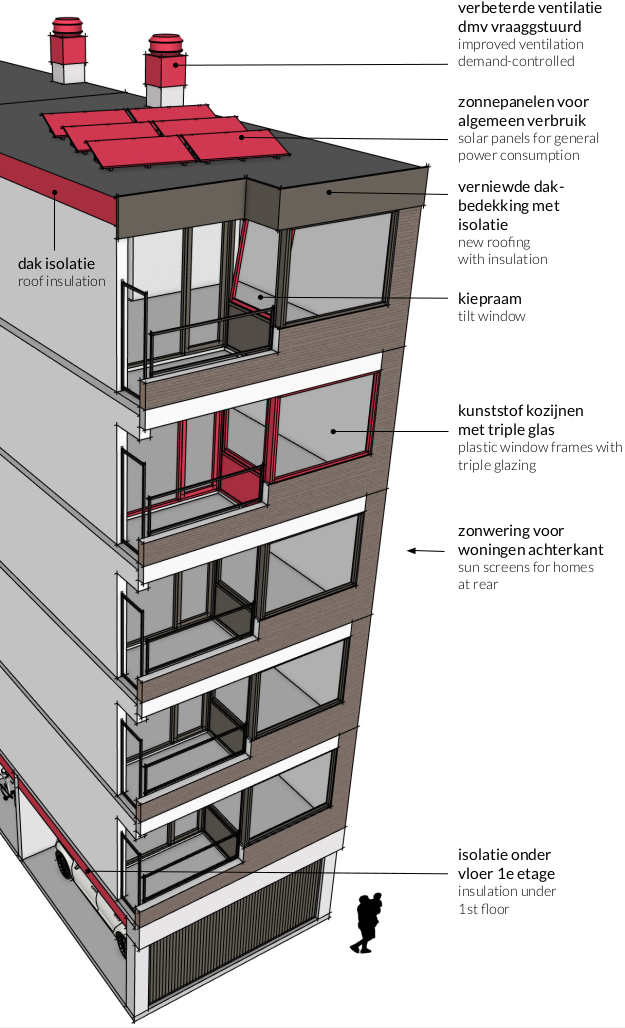
Yes, the floor insulation will be underneath the lowest apartments, so above the entrance and the storage rooms.
Will things need to get broken when the new ventilation system will be installed in the kitchen/bathroom?
Each apartment will be assessed individually, because every apartment is different on the inside. The only thing that will happen for the ventilation is the replacement of the
valves by a one that has a sensor. As long as these valves are easily accessible there should be no problem.
Will the windows reach the ground? What about the radiator in front of it?
Yes, the windows of the door and the window next to it (near the balcony) reach the ground (the tilt window and the large window do not). If there is a radiator in
front of the window that reaches the ground, it will be placed on legs in front of the glass.
Can the radiator also be moved or changed?
That is possible, but not within the sustainability project. Owners can take care of this themselves. Our urgent advice is to do this in consultation with the homeowners' association,
preferably before the end of the renovation project.
Does triple glazing keep heat out?
Yes, but also inside. That is why the window shades at the back are also important.
Is it true that tilt windows are now becoming standard?
Yes, that is correct. We considered it as an individual option, but it saves a significant amount of money to make it standard for everyone.
Will there be compensation for custom-made curtains that no longer fit the new windows?
No, only a budget of 250 euros per apartment has been reserved for the removal of self-installed fixtures.
During the intake ("warme opname"), the contractor will assess which self-installed fixtures need to be removed and will make a proposal
to remove them and to reinstall them after the work has been completed.
Do self-installed additions (such as decking) have to be removed from the balcony when the window frames are installed?
In principle, all obstacles and self-installed parts within 2 metres of the work area must be removed in order to be able to work properly and safely, and
without risking damage to your property. We will check whether this also applies to decking etc. However, the contractor has the final say in this.
There is a plaster wall attached to my window frame to create an extra room, does this also need to be removed?
Probably. In any case, the connection to the existing frame needs to be broken, and space is needed to install the new frame.
How much time will this take for the residents? Is it in the evenings/weekends?
The work to install the window frames takes 4 days. This is done during the day, and for this the owners/residents will have to be at home or hand over a key.
In addition, a couple of appointments will be made to come once to look at the condition of the apartment in advance, once for the heating, and once for the ventilation.
How will safety be ensured when removing the asbestos?
To quote the company that we hired for the model apartment:
"During internal remediation, a containment is constructed. This containment is fully pressurized using professional equipment. This pressurization is continuously monitored. Here too, only remediators equipped with personal protective equipment are permitted to enter the area. Once the asbestos source has been removed, the laboratory will inspect the space. This inspection involves placing pumps in the containment, which sample the air for asbestos fibers for two hours. The filters in the pumps are then assessed, and if they fall within normal limits, the area is released. For a 2a remediation, measurements are taken for four hours using gold-vaporized filters, and adhesive samples are taken from the horizontal sections of the containment.
After the containment is demolished, the space may be re-entered."
The removal, cleaning, and measuring methods are all in compliance with strict national
laws and standards (NEN 2990).
Where will the air vents be?
In the place where the small hatches are now, above the doors.
How will demand-driven air ventilation work?
New valves will be installed on the exhaust ducts in the apartments. How far open these valves are is smartly determined by a sensor in the home based on CO2 and
moisture content. In addition, the fan on the roof can run more or less depending on the total demand per duct.
Will the air ventilation in the hallway also be improved?
The ventilation of the hallways is outside the scope of the sustainability project. We certainly recognize the problem in the hallways. It is often musty and warm there. Possibly
the approach to ventilation per home also has an influence or consequences on the ventilation of the hallways. If something needs to be adjusted in the system, then
that is a good time to also look for improvements for the hallways. We are trying to find smart solutions for this within the sustainability project.
How will the (1-on-1) round table discussions work?
We will conduct a survey in mid-July and invite people to the discussions at the end of August and the beginning of September. We will include time slots
specifically for English-speaking owners. We will announce though e-mail when it is possible to register a time slot.
When will construction start?
In 2026. It will be announced well in advance when it will be exactly.
Are all owners aware of the sustainability project?
Throughout the preparations, we have tried to keep all owners up to date through mail, e-mail, and various digital and physical meetings.
Will all the window frames be replaced?
The window frames that border the outside of the building will be. Internal doors will remain as they are.
Do the storage units downstairs have to be empty when the floor insulation is applied?
Yes, the storage unit must be empty when the floor insulation is installed.
The emptying of the storage units will be done by professionals. You only need to hand over a key of the storage unit.
Will the apartments remain habitable during the renovation?
Mostly yes, except for the two days when the window frames are replaced.
What will be the individual options?
The sliding door discussed earlier turned out to be technically impossible, and the tilt window will be standard.
The window shades will be a "mandatory" option for the apartments at the back of the building.
I have not received my personal calculation
Please contact us through the contact form or through e-mail.
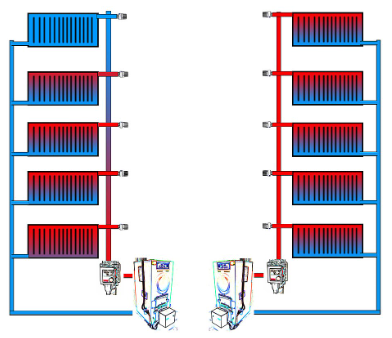
What is hydronic balancing?
This process ensures that everyone gets the same amount of hot water in the pipelines, regardless of the distance to the water heater. See the image below: On the left the current
situation. On the right the desired situation.